Libertarian Fictions

Featured

A drawing of a jester in a pointy hat. His body is a book and he is holding a book.
Because the world does not obey their ideology, libertarians prefer to send us to fictional places where their ideas actually work.

Libertarians love making stuff up. I don’t mean the counterfactual stories they tell when you point out some wonderful thing the government has supplied such as the eradication of smallpox, aka World’s Greatest Killer. Facts like that are always met with the response, “Well, a free market would have eradicated smallpox better, stronger, faster.” These fact-free assertions probably make them feel better, but I doubt anyone save the libertarian tribe takes them seriously. As Naomi Oreskes and Erik Conway argue, the libertarian free market existed “precisely never. There has never been a time in human history when markets met these conditions, and there is no reason to think that such conditions could ever exist” (p. 418). Nor am I discussing the truly dangerous fiction they peddle to the world, such as the “Great Barrington Declaration” on the Covid pandemic or the fantasy of climate-change denialism, largely fueled by libertarians and their fossil-fuel-burning patrons. Or the “right” to poison themselves with raw milk. Thank goodness we took care of smallpox before the libertarian propaganda machine got going. “The solution is not vaccines but herd immunity!” “Um, actually, there is no proof that smallpox ever killed anyone!” or “It is my right to get a highly contagious disease with a 35% mortality rate! My body is my property!” No, my subject here is the actual make-believe world at the heart of libertarian ideology. If allowed to create a world in line with their politics, what would that world look like?”

Galt’s Gulch

A gulch in Rocky Mountain National Park in Colorado
An actual gulch in Rocky Mountain National Park in Colorado. I’m sure no one would notice if it suddenly went missing.

Ayn Rand’s Atlas Shrugged (1957) is for those who think the problems of the world owe to the fact that people aren’t selfish enough and things would be better off if the good people just retreated to Galt’s Gulch and let a few billion people die as a result. These billions are “parasites” and, although Rand does not tell us directly, obviously must include the disabled and children. In Rand’s tale, those looters deserve to die.

Rand’s heroes are Übermenschen who retreat to a mysterious “Galt’s Gulch” hidden in the Colorado mountains and create a capitalist utopia. How does it remain hidden in a state where the federal government owns about a third of the real estate? Rand never explains this problem. In this place, these fierce individualists, beholden to no one but themselves, must take an “Galt’s Oath” named after cult leader founder John Galt to never give anything to anyone. What happens if someone, asserting their individuality does not take the oath? Rand never tells us. True individualism, it turns out is not thinking for yourself but acting and thinking exactly like Rand Galt does. You may want to feed your children and expect nothing in return, but that is a violation of the Galt’s Prime Directive so you should charge them or let them starve. If you choose to give them food, you aren’t an individualist. In Rand’s account, Galt’s Gulch is almost entirely populated by men. We can assume that the rugged individualist man returning home after working ruggedly individualistically is presented a bill by his ruggedly individualistic wife for doing laundry and vacuuming. I assume that she only prepared dinner for herself, and if he wants to eat, that will cost him.

What happens if a parasitic looter enters the gulch? Well, that’s impossible, you see because Galt created a mysterious shield that made the Gulch invisible. Does he give this protection to all inhabitants in violation of his oath? Rand never notes how he is paid for it, nor does she explain what would happen to a free-rider who doesn’t pay Galt yet obviously remains protected from the looters. There is no police force to enforce the (unwritten?) contract between Galt and the inhabitants.

In this capitalistic paradise, there are mineral mines and industrial production. What happens to the pollution caused by these enterprises? Rand is silent on this. Are children allowed (or required) to pay their way by working in a mine with no safety standards? Rand doesn’t say. Colorado has a semi-arid climate and the politics of water use are intense. Rand does not mention of where the water for all this comes from. Even a parasitic looter who works for the State of Colorado would notice the missing water. However, Rand just fiats away any real-world problems and hopes that no one notices them.

Despite her claims that her system is realistic and rational, Rand’s utopia is rife with contradictions and waves away any true problems of the world, “Rand’s utopia is not only inconsistent in description but simply not plausible in reality. Her idealized version of society is flawed in terms of sociological and economic and political laws and rests on a distorted view of human psychology” (p. 258)

Gumption Island

Largely forgotten today, Felix Morley (1894-1982) was a giant of the post-World War II libertarian movement. He won a Pulitzer for his editorial writing at the Washington Post, criticizing Roosevelt and the New Deal. After World War II, Morley wrote regular columns for Nation’s Business and Barron’s Weekly, co-founded the conservative newspaper Human Events, and enjoyed regular broadcast gigs on radio and television:

Morley was also on the advisory board of Spiritual Mobilization, a libertarian organization that promoted free-market ideas to the clergy, and he was a founding member of the Mont Pererin Society. The libertarian Volker Fund awarded Morley the William Volker Distinguished Service Award in 1961.

In 1956, Morley published Gumption Island, a novel he described as a “political fantasy,” in which Gibson Island, where Morley made his home was transformed into a libertarian utopial. Morley wanted to use his novel to both explain his ideal political order and to to explore race relations, “Knowing this island and its people, both white and black, I have long speculated how they would react, individually and collectively, if thrown into a ‘state of nature” (Morley to J.H. Gipson, March 19, 1954, Box 33 in Morley Papers, Hoover Presidential Library). Much more than his non-fiction, Gumption Island reveals the racism underneath Morley’s political thought.

In the novel, the Soviets drop a “Q-bomb” which sends a small island of homeowners back to the age of the dinosaurs and they must create a livable political order. There are two notable aspects of Morley’s politics, as revealed in the book that bear mentioning.

First, Jews controlled money and banking on the island. Albert Adler, one of the island’s few Jews, argued that money had to be fixed to the gold standard to prevent the manipulation of currency by government. He argued,’ For good historical reasons, every intelligent Jew understands the significance of gold. As a matter of fact, between ourselves, I’m wearing a beltful of double eagles at this minute. I’ve never travelled anywhere without them, since 1932. It’s funny to think that now I’ve carried these five hundred gold dollars back fifty million years” (92).  Finally, Adler lends the community his gold with the guarantee that there will be no manipulation of the gold reserve and that he and another person will be in complete control of the bank and have the sole power to appoint their own successors. Later in the novel, a motion is made to force the bank to pay the profits of the bank to the island’s Director of Finance. Adler blocks the move by telling the islanders, “If that motion is carried…I may feel it necessary to withdraw the gold reserve, which is not an asset of the bank, but a personal loan of my private property.” Morley thus recreates the stereotype of the money-grubbing Jew, the sole control of the economy.

Second, Morley wrote all African-American characters in a minstrel show dialect, even though by the 1950s such a dialect was increasingly recognized as reflecting an ugly racist stereotype. White immigrant characters, such as the Polish immigrant who connived with the Soviets to set the Q-bomb, as well as a Russian pilot who had been thrown into the past with the Gumption Island residents, were presented as speaking unaccented English. While listening to the white islanders discussing Plato, Bill Jefferson, portrayed as a leader in the African-American community, thinks to himself, “I guess…that Ah jes’ ain’t intellectualy competent. With all this yak-yak, they’s clean forgot Ah’s supposed to pick up a load o’ wood fo’ the hospital.” After he returned to the African-American community and reported what he had seen and heard in the white home, they agreed not to participate in governing the island. As one character put it, “I guess we got to leave it to the white folks to give the orders…so long as they treat us decent.” In Morley’s libertarian social order, African Americans happily give up any political power because they realize their own incapacity to govern.

In the 1950s libertarians imagined their utopias as places where pollution didn’t exist, where children were “free” to work or starve, and where “individualism” meant surrendering your free choice to act altruistically. A place where the Jewish racial trait of hoarding gold allowed them to control the economy, and African Americans were happy in their servitude. You and I might call such places nightmares, but libertarians call them paradise.

This work is licensed under a Creative Commons Attribution-NonCommercial-ShareAlike 4.0 International License.
Defamation and Nathan Cofnas

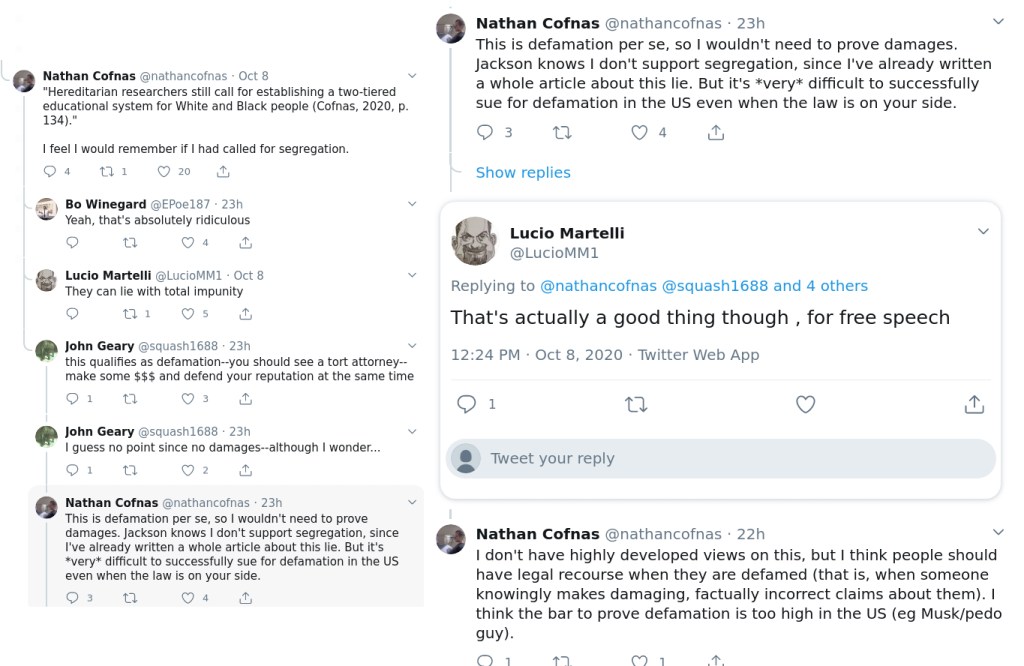
Nathan Cofnas @nathancofnas - Oct 8 v “Hereditarian researchers still call for establishing a two-tiered educational system for White and Black people (Cofnas, 2020, p. 134)." 
| feel | would remember if | had called for segregation. 
O4 1 Ow wf 
@& Be Winegard oePoeis7 23h v Yeah, that's absolutely ridiculous 
2o u Oa & 
@ Lucio Marteiti aLuciovinit Oct 8 They can lie with total impunity 
2 ai Os & 
@ John Geary @squash1688 23 v this qualifies as defamation--you should see a tort attorney-- make some $$$ and defend your reputation at the same time 
O11 ua O3 ag 
@ John Geary asquash1688 23h v I guess no point since no damages-although | wonder... 
O1 a O2 a 
@ Nathan Cofnas @nathancofnas - 23h v This is defamation per se, so | wouldn't need to prove damages. Jackson knows | don't support segregation, since I've already written a whole article about this lie. But it's *very* difficult to successfully sue for defamation in the US. even when the law is on your side. 
O3 a UE fy 
Nathan Cofnas @nathancofnas - 23h v 
This is defamation per se, so | wouldn't need to prove damages. 
Jackson knows | don't support segregation, since I've already written 
a whole article about this lie. But it's *very* difficult to successfully 
sue for defamation in the US even when the law is on your side. 
O3 O44 
Show replies 
: Lucio Martelli v 
@LucioMM1 
Replying to @nathancofnas @squash1688 and 4 others 
That's actually a good thing though , for free speech 
12:24 PM - Oct 8, 2020 - Twitter Web App 
O11 wv g 
[> 
- e Tweet your reply 
Nathan Cofnas @nathancofnas - 22h v 
| don't have highly developed views on this, but | think people should 
have legal recourse when they are defamed (that is, when someone 
knowingly makes damaging, factually incorrect claims about them). | 
think the bar to prove defamation is too high in the US (eg Musk/pedo 
guy). 
Oo} a7 O71 a
Nathan Cofnas does not have “highly developed views” on what counts as defamation.

The paper Andrew Winston and I wrote* on the mythical taboo on race/intelligence research has caused a mini-stir over on Twitter. Nathan Cofnas is particularly upset, claiming I have defamed him. A polite word for Cofnas’s claim is “nonsense.” There are many impolite words that you could substitute for that one. Let me explain why.

Cofnas claims that I wrote he advocated racial segregation. He first made the accusation on Twitter and then wrote a blog post about it. He begins by objecting to this Daily Nous post and claims that I resurrected the idea that he was an advocate of racial segregation. But, here’s what I wrote:

Hereditarian researchers still call for establishing a two-tiered educational system for White and Black people (Cofnas, 2020, p. 134).

Cofnas writes: “John Jackson knew this was false because (a) it’s ridiculous and (b) he was aware of my article in Spectator USA, which explicitly addressed this lie. But now the claim that I advocate segregation has become the go-to smear on Twitter.”

Here’s the problem. The line that so offends Cofnas does not claim that Cofnas advocates segregation.” The sentence does not even attribute the “two-tiered” idea as one advocated by Cofnas, but one advocated by “hereditarian researchers” when they call call for a “two-tiered educational system for White and Black people.” Here is Cofnas making that exact claim:

But the reason that these programs, which Kourany rightly says ought to exist, have never been created is not because of racism but because of the taboo on talking about genetic differences among policy makers. No mainstream politician can acknowledge that there are differences that might call for the creation of a program to “work with the strengths and work on the weaknesses of every [ethnic] group to help make them the very best they can be.” It is hereditarians who have advocated these programs and environmentalists who have resisted them. The abstract to Jensen’s (1969) paper –

It could not be more clear that, in this quotation from Cofnas’s paper, he claims that hereditarians have advocated educational programs based on “ethnic” groups. He then cites the following scholars as evidence that hereditarians advocate such programs:

  • Gottfredson, L. S. (2005a). Suppressing Intelligence Research: Hurting Those We Intend to Help. In R. Wright & N. A. Cummings (Eds.), Destructive trends in mental health: The well-intentioned path to harm (pp. 155–187). Routledge.
  • Gottfredson, L. S. (2005b). What if the hereditarian hypothesis is true? Psychology, Public Policy, and Law, 11, 311–319.
  • Jensen, A. R. (1969). How much can we boost IQ and scholastic achievement? Harvard Educational Review, 39, 1–123.
  • Lubinski, D., & Humphreys, L. G. (1997). Incorporating general intelligence into epidemiology and the social sciences. Intelligence, 24, 159–201.

It is perfectly correct, therefore, to cite Cofnas’s paper to evidence the claim that hereditarians advocate a “two-tiered” system of education based on racial or, if you prefer, “ethnic,” groups. There seems to be ample evidence, supplied by Cofnas himself, that hereditarian researchers advocate for these kinds of programs. For a devastating critique of the idea that education should be tailored in such a way, see this wonderful post by Jonathan Kaplan.

Cofnas is spinning the idea that I claimed he advocated segregation out of whole cloth. I wrote an entire book about psychologists who did use their science to advocate for Jim Crow segregation–an ugly history that contemporary hereditarians pretend never happened. In that book, I made quite clear that Jensen disavowed the use of his research to support Jim Crow when arch-segregationist, Carleton Putnam attempted to recruit him to the cause:

William Shockley was soon joined by a quieter and more sophisticated voice, Berkeley psychologist Arthur Jensen, whose 1969 article in the Harvard Educational Review claimed that white and black differences in IQ scores were genetic in nature and impervious to environmental modification. Even before his 1969 article Putnam was writing to Jensen, offering his services as a liaison between Jensen and high-level governmental officials. In 1968, Putnam noted how important it was for Jensen’s findings to be “rapidly disseminated and implemented as quickly as possible.”18 Jensen, however, maintained that nothing in his work lent any support to the racial segregation of schools. A few years after Jensen’s 1969 article was published, in long lunch meeting, Putnam “took pains to explain our view of the inconsistency of [Jensen’s] position on the existence of innate race differences when compared with his stand on school integration.” Jensen, however, was unmoved and continued to insist that his work did not lend support to the segregationist cause.19

Of course, even while denying his work could support segregation, Jensen happily collaborated with them when he testified in front of Congress alongside segregationists, cited a neo-Nazi to define races in his 1969 article, and touted his eugenic fantasies for a notorious white supremacist website. Cofnas was silent when I pointed out that his work was praised at those white supremacist websites.

Hereditarians simply ignore the uses to which the radical right put their work. They prefer to take on the role of innocent victim and attack those who simply read and report on what they have written correctly.

*Andrew co-wrote the paper with me but the passage that offends Cofnas was mine and I take full responsibility for it. Andrew is not writing this blog which represents only my opinions, not his.


This work is licensed under a Creative Commons Attribution-NonCommercial-ShareAlike 4.0 International License.

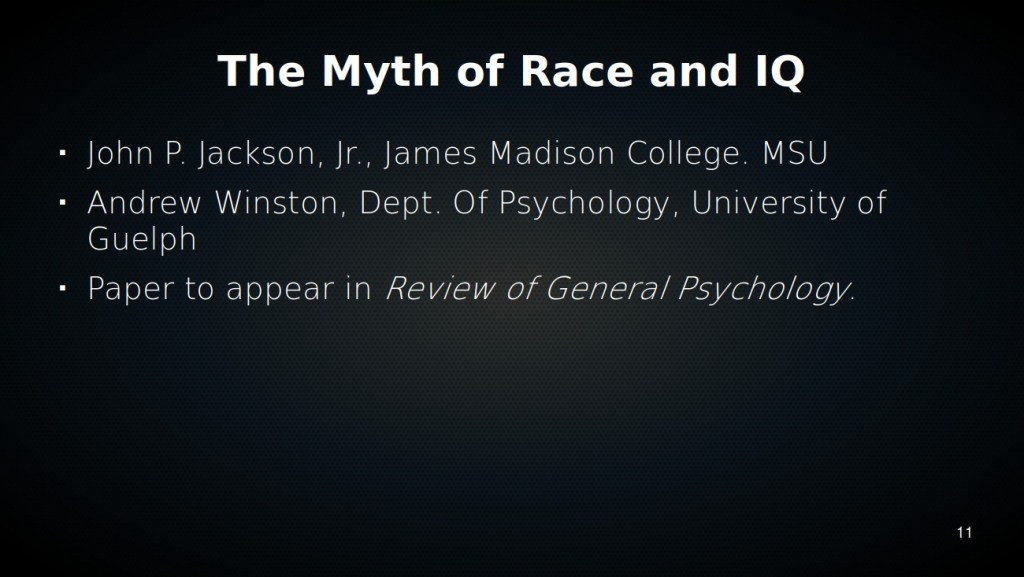
The Myth of Race and IQ

This paper is now accessible here.

The Psychology Department here at Michigan State very kindly invited me to give a Zoom brownbag talk on my work. I spoke on a paper I co-authored with Andrew Winston that will soon appear in the Review of General Psychology on the myth that there is a “taboo” on race/IQ research [One day later: The paper is out! You can access it here.]. Like many aspects of “cancel culture” there is almost no evidence that such a taboo exists. Here’s the paper abstract:

You can view the talk here. I’m very grateful to the Department of Psychology for the opportunity to share our work. Naturally, they are not responsible for anything I said.


This work is licensed under a Creative Commons Attribution-NonCommercial-ShareAlike 4.0 International License.

Arthur Jensen’s Racist Eugenics

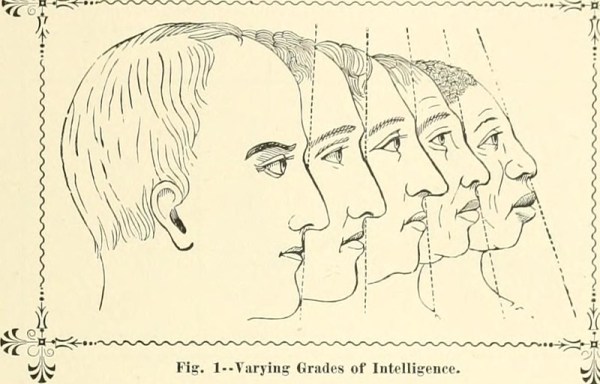
Sketches of head showing "Varying Grades of Intelligence" by associating them with race

Arthur Jensen’s works simply recapitulated racist stereotypes of the 19th century.

For the last four decades of his career psychologist Arthur Jensen (1922-2012), was the most visible and vocal proponent for the claim that African Americans were genetically less intelligent than white people. He and many of his supporters trumpeted his statistical proficiency as proof he was simply an objective scientist asking hard questions and discovering uncomfortable truths. He continually claimed he was asking factual questions and not giving any policy recommendations.

That last bit is utter nonsense. Throughout his long career, Jensen warned about stupid Black people outbreeding smart white people. In his famous 1969 article he wrote:

Certain census statistics suggest that there might be forces at work which could create and widen the genetic aspect of the average difference in ability between the Negro and white populations in the United States, with the possible consequence that the improvement of educational facilities and increasing equality of opportunity will have a decreasing probability of producing equal achievement or continuing gains in the Negro population’s ability to compete on equal terms…..Is there a danger that current welfare policies, unaided by eugenic foresight, could lead to the genetic enslavement of a substantial segment of our population? The possible consequences of our failure seriously to study these questions may well be viewed by future generations as our society’s greatest injustice to Negro Americans. (p. 95)

Look out white Americans! Racial inferiors are putting your civilization at risk! Two years before his 1969 article, Jensen made this quite clear. He endorsed discouraging or preventing people of lower intelligence from reproducing, what is thought of as negative eugenics rather than trying to encourage smart people to reproduce, which would be postitive eugenics:

A lowering [of IQ] by as much as one standard deviation would probably make civilization impossible.

The reasonable answer I believe, is to think at present only in terms of negative eugenics rather than in terms of positive eugenics. That is to say, there are probably traits which have no conceivable survival value and which all humane persons would agree are human misfortunes which should be prevented if at all possible.

Jensen’s dysgenic nightmare was shared by the racist right of American politics, a fact that his admirers always chose to ignore. Hence, when the psychological journal Intelligence proclaimed Arthur Jensen, “A King Among Men” (seriously?), both American Renaissance and Vdare eagerly agreed with Jensen’s ascension to the throne.

Continue reading

Guest Post: On the intellectual dishonestly of recent hereditarian papers, Part Three

This is the third of three guest posts by Professor Jonathan Kaplan of Oregon State University (see Part One here and Part Two here).  Professor Kaplan is a noted philosopher of biology who has published extensively on biological race and IQ among other topics.

Part Three: When a Paper Doesn’t Take Its Own Thesis Seriously

I’ll end this series with the paper with which I have the longest history – Jonathan (“Jonny”) Anomaly’s 2017 “Race Research and the Ethics of Belief.” I was one of the Very Mean ReviewersTM that Anomaly wrote a blog post about, and yes, in my review I suggested that the paper was unpublishable. Clearly I was wrong, as it made its way into print in more or less the same form that I originally read. But pace Anomaly’s interpretation, my main complaint about the paper, as a reviewer, had little to do with the paper’s (weak) defense of hereditarianism (though my scorn for Nicholas Wade’s shoddy defense of scientific racism was openly and forcefully expressed in my review). Rather, my main complaint was focused on what I viewed as the paper’s more or less entirely incoherent argument structure.

I’ll note at the outset that some readers may find this account to be, as John Jackson put it, a little bit “inside baseball.” The gap between what the paper purports to do, and what it actually goes, is stark, but making sense of what the paper purports to do does get us a bit into actual philosophy (that isn’t even about race).

Continue reading

Guest Post: On the intellectual dishonestly of recent hereditarian papers, Part Two

This is the second of three guest posts by Professor Jonathan Kaplan of Oregon State University (see Part One here).  Professor Kaplan is a noted philosopher of biology who has published extensively on biological race and IQ among other topics.

Part II. A paper about policy that doesn’t engage with policy

Cofnas’s recent piece,1 published in journal Philosophical Psychology, is problematic for a different reason than Winegard, Winegard, and Anomaly – it simply fails to do what it claims. The very title of the paper “Research on group differences in intelligence: A defense of free inquiry,” points towards its absurdity. As many people immediately pointed out, research on group differences in intelligence has been pursued and published regularly, and there are no limits on “free inquiry” around it.2 At least, no more so than there are limits on “inquiry” surrounding climate change skepticism or claims about the dangers of routine childhood vaccinations. In each case, what there is, instead, is a broad consensus among experts who actually engage with research of the relevant kind that the claims being made are too often wildly ill-supported (often already having been shown to be wrong), and the implications drawn by supporters on the basis of these ill-supported claims are often far too strong. When researchers argue that reasonable people of goodwill should not pursue bad research that purports to support certain kinds of conclusions about group differences in intelligence, or certain kinds of conclusions about anthropogenic climate change, or certain kinds of conclusions about the safety of vaccine, they are not arguing against “free inquiry,” but rather in favor of not pursuing grossly irresponsible research.

Continue reading

Guest Post: On the intellectual dishonestly of recent hereditarian papers, Part One

This is the first of three guest posts by Professor Jonathan Kaplan of Oregon State University.  Professor Kaplan is a noted philosopher of biology who has published extensively on biological race and IQ among other topics.

Part One: Introduction and Misleading Comparisons

In this series of blogposts, I discuss three relatively recent papers that, in one way or another, defend the so-called hereditarian hypothesis – the claim that genetic differences between human populations identified as ‘races’ are causally responsible for realized differences in cognitive abilities as measured by I.Q. test-taking ability, in a straightforward way via developmental effects on e.g. neurobiology (rather than through e.g. racism and the legacies of racism associated with racial ascriptions). But my main point in these posts is not to engage directly with the arguments put forward in defense of that hypothesis; these have been confronted many times before, and found seriously wanting. Rather, my goal is to think more about the structure and stated aims of those papers, and the ways in which the papers fail to take seriously their responsibility to honestly present their own arguments, and to honestly engage with the relevant literature.

Continue reading

Whitewashing Scientific Racism: Revisiting the Equalitarian Myth

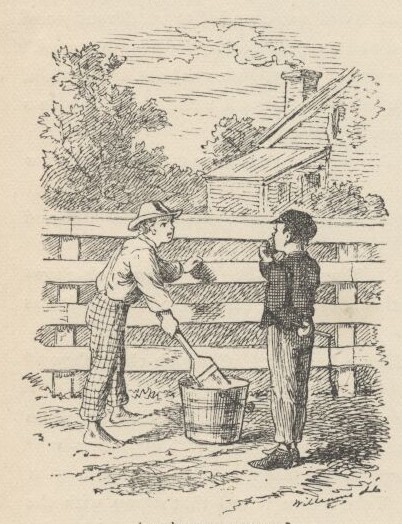
Tom Sawyer whitewashing the fence

“Say, Tom, let me whitewash a little.”

It is one of the most famous scenes in literature: Aunt Polly commands Tom Sawyer to whitewash the front fence in punishment for some misdeed. Clever Tom pretends it is a joy to whitewash the fence and soon has tricked all his friends into whitewashing the fence for him, indeed, they pay him for the privilege. Similarly, Race Differences in Intelligence (RDI) researchers as well as outright racists often trick mainstream scholars into whitewashing the ugly history of their activities.

A perfect example is this article in the psychology journal, Intelligence where we are presented with an analysis of “controversies in the field of intelligence research.” It is a scientometric analysis meaning it is a quantitative account of such controversies as reported in the scientific literature. There is nothing wrong with that in principle but often such work needs supplementation by a detailed account of specific incidents in the database. As Lorraine Daston recently explained:

if you are looking for causal mechanisms, often only a detailed ethnography will reveal what exactly is the cause of some observed pattern in behavior. And it can work in the other direction — a hypothesis developed from ethnographic work may require statistical testing. These two modes of inquiry, so often opposed to each other, seem to me to work hand-in-glove, at least from the standpoint of the goals of scientific explanation.

Following Daston’s advice, it behooves us to look as some of the incidents in the article in order to get the clearest picture of the listed “controversies in the field of intelligence research” and what is missing from that picture.

Continue reading

Race and IQ. Again.

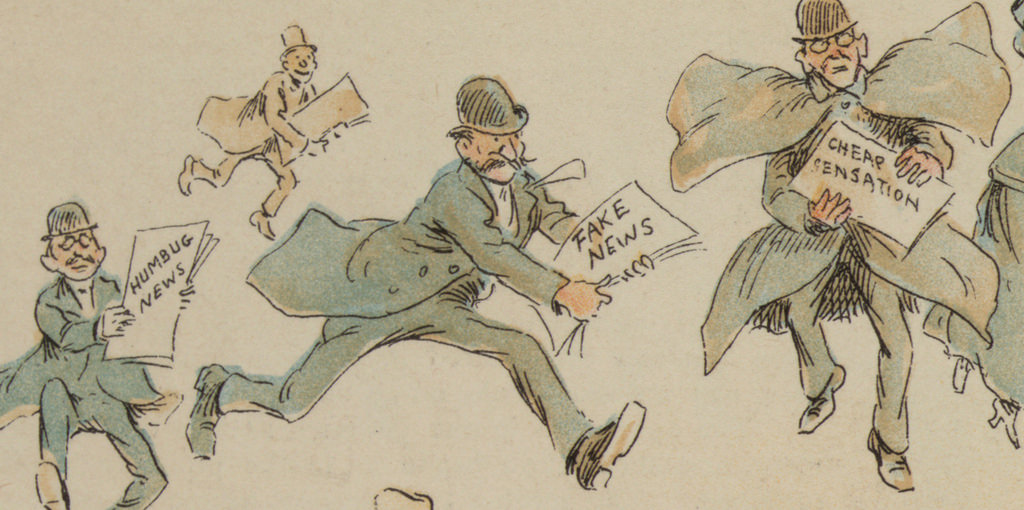
Drawn figures with newspapers with headlines reading

Reading the Latest Article on Race Differences in Intelligence

Race Difference in Intelligence (RDI) researchers have been trying to prove their case since World War I when psychologists administered intelligence tests to those entering the Army. It won’t surprise you to learn that one outcome of this mass testing  was the blustery assurance among psychologists that at last we had definitive proof of differences in intelligence between the races. However, the case soon fell apart and RDI researchers, the honest ones at least, issued embarrassed recantations. Most famous of these was Carl Brigham who wrote in 1930:

This review has summarized some of the more recent test findings which show that comparative studies of various national and racial groups may not be made with existing tests, and which show, in particular, that one of the most pretentious of these comparative racial studies-the writer’s own-was without foundation.

Brigham was merely echoing many other researchers who realized that intelligence tests could never really prove that white people are smarter than black people and not much could be done about it.  For the past century, however, a few RDI researchers always lumbered on, promising that, any day now, we are right on the brink, success is just around the corner, just fifteen more minutes!, and we will have proof that most of the racial gap in IQ owes to genetics.

The latest entry into the jam-tomorrow-never-jam-today of RDI researchers is this piece by philosopher Nathan Cofnas who assures us that “In a very short time” we will know that black people are just generally dumber than white people (I paraphrase here, but that is what he means) . It is never a good sign when an article comes with a warning label as this one did. The editors claimed their decision was “based on criteria of philosophical and scientific merit, rather than ideological conformity.” One wonders what merit the editors found in the article since it has none of these promised virtues.

Continue reading