Libertarian Fictions

Featured

A drawing of a jester in a pointy hat. His body is a book and he is holding a book.
Because the world does not obey their ideology, libertarians prefer to send us to fictional places where their ideas actually work.

Libertarians love making stuff up. I don’t mean the counterfactual stories they tell when you point out some wonderful thing the government has supplied such as the eradication of smallpox, aka World’s Greatest Killer. Facts like that are always met with the response, “Well, a free market would have eradicated smallpox better, stronger, faster.” These fact-free assertions probably make them feel better, but I doubt anyone save the libertarian tribe takes them seriously. As Naomi Oreskes and Erik Conway argue, the libertarian free market existed “precisely never. There has never been a time in human history when markets met these conditions, and there is no reason to think that such conditions could ever exist” (p. 418). Nor am I discussing the truly dangerous fiction they peddle to the world, such as the “Great Barrington Declaration” on the Covid pandemic or the fantasy of climate-change denialism, largely fueled by libertarians and their fossil-fuel-burning patrons. Or the “right” to poison themselves with raw milk. Thank goodness we took care of smallpox before the libertarian propaganda machine got going. “The solution is not vaccines but herd immunity!” “Um, actually, there is no proof that smallpox ever killed anyone!” or “It is my right to get a highly contagious disease with a 35% mortality rate! My body is my property!” No, my subject here is the actual make-believe world at the heart of libertarian ideology. If allowed to create a world in line with their politics, what would that world look like?”

Galt’s Gulch

A gulch in Rocky Mountain National Park in Colorado
An actual gulch in Rocky Mountain National Park in Colorado. I’m sure no one would notice if it suddenly went missing.

Ayn Rand’s Atlas Shrugged (1957) is for those who think the problems of the world owe to the fact that people aren’t selfish enough and things would be better off if the good people just retreated to Galt’s Gulch and let a few billion people die as a result. These billions are “parasites” and, although Rand does not tell us directly, obviously must include the disabled and children. In Rand’s tale, those looters deserve to die.

Rand’s heroes are Übermenschen who retreat to a mysterious “Galt’s Gulch” hidden in the Colorado mountains and create a capitalist utopia. How does it remain hidden in a state where the federal government owns about a third of the real estate? Rand never explains this problem. In this place, these fierce individualists, beholden to no one but themselves, must take an “Galt’s Oath” named after cult leader founder John Galt to never give anything to anyone. What happens if someone, asserting their individuality does not take the oath? Rand never tells us. True individualism, it turns out is not thinking for yourself but acting and thinking exactly like Rand Galt does. You may want to feed your children and expect nothing in return, but that is a violation of the Galt’s Prime Directive so you should charge them or let them starve. If you choose to give them food, you aren’t an individualist. In Rand’s account, Galt’s Gulch is almost entirely populated by men. We can assume that the rugged individualist man returning home after working ruggedly individualistically is presented a bill by his ruggedly individualistic wife for doing laundry and vacuuming. I assume that she only prepared dinner for herself, and if he wants to eat, that will cost him.

What happens if a parasitic looter enters the gulch? Well, that’s impossible, you see because Galt created a mysterious shield that made the Gulch invisible. Does he give this protection to all inhabitants in violation of his oath? Rand never notes how he is paid for it, nor does she explain what would happen to a free-rider who doesn’t pay Galt yet obviously remains protected from the looters. There is no police force to enforce the (unwritten?) contract between Galt and the inhabitants.

In this capitalistic paradise, there are mineral mines and industrial production. What happens to the pollution caused by these enterprises? Rand is silent on this. Are children allowed (or required) to pay their way by working in a mine with no safety standards? Rand doesn’t say. Colorado has a semi-arid climate and the politics of water use are intense. Rand does not mention of where the water for all this comes from. Even a parasitic looter who works for the State of Colorado would notice the missing water. However, Rand just fiats away any real-world problems and hopes that no one notices them.

Despite her claims that her system is realistic and rational, Rand’s utopia is rife with contradictions and waves away any true problems of the world, “Rand’s utopia is not only inconsistent in description but simply not plausible in reality. Her idealized version of society is flawed in terms of sociological and economic and political laws and rests on a distorted view of human psychology” (p. 258)

Gumption Island

Largely forgotten today, Felix Morley (1894-1982) was a giant of the post-World War II libertarian movement. He won a Pulitzer for his editorial writing at the Washington Post, criticizing Roosevelt and the New Deal. After World War II, Morley wrote regular columns for Nation’s Business and Barron’s Weekly, co-founded the conservative newspaper Human Events, and enjoyed regular broadcast gigs on radio and television:

Morley was also on the advisory board of Spiritual Mobilization, a libertarian organization that promoted free-market ideas to the clergy, and he was a founding member of the Mont Pererin Society. The libertarian Volker Fund awarded Morley the William Volker Distinguished Service Award in 1961.

In 1956, Morley published Gumption Island, a novel he described as a “political fantasy,” in which Gibson Island, where Morley made his home was transformed into a libertarian utopial. Morley wanted to use his novel to both explain his ideal political order and to to explore race relations, “Knowing this island and its people, both white and black, I have long speculated how they would react, individually and collectively, if thrown into a ‘state of nature” (Morley to J.H. Gipson, March 19, 1954, Box 33 in Morley Papers, Hoover Presidential Library). Much more than his non-fiction, Gumption Island reveals the racism underneath Morley’s political thought.

In the novel, the Soviets drop a “Q-bomb” which sends a small island of homeowners back to the age of the dinosaurs and they must create a livable political order. There are two notable aspects of Morley’s politics, as revealed in the book that bear mentioning.

First, Jews controlled money and banking on the island. Albert Adler, one of the island’s few Jews, argued that money had to be fixed to the gold standard to prevent the manipulation of currency by government. He argued,’ For good historical reasons, every intelligent Jew understands the significance of gold. As a matter of fact, between ourselves, I’m wearing a beltful of double eagles at this minute. I’ve never travelled anywhere without them, since 1932. It’s funny to think that now I’ve carried these five hundred gold dollars back fifty million years” (92).  Finally, Adler lends the community his gold with the guarantee that there will be no manipulation of the gold reserve and that he and another person will be in complete control of the bank and have the sole power to appoint their own successors. Later in the novel, a motion is made to force the bank to pay the profits of the bank to the island’s Director of Finance. Adler blocks the move by telling the islanders, “If that motion is carried…I may feel it necessary to withdraw the gold reserve, which is not an asset of the bank, but a personal loan of my private property.” Morley thus recreates the stereotype of the money-grubbing Jew, the sole control of the economy.

Second, Morley wrote all African-American characters in a minstrel show dialect, even though by the 1950s such a dialect was increasingly recognized as reflecting an ugly racist stereotype. White immigrant characters, such as the Polish immigrant who connived with the Soviets to set the Q-bomb, as well as a Russian pilot who had been thrown into the past with the Gumption Island residents, were presented as speaking unaccented English. While listening to the white islanders discussing Plato, Bill Jefferson, portrayed as a leader in the African-American community, thinks to himself, “I guess…that Ah jes’ ain’t intellectualy competent. With all this yak-yak, they’s clean forgot Ah’s supposed to pick up a load o’ wood fo’ the hospital.” After he returned to the African-American community and reported what he had seen and heard in the white home, they agreed not to participate in governing the island. As one character put it, “I guess we got to leave it to the white folks to give the orders…so long as they treat us decent.” In Morley’s libertarian social order, African Americans happily give up any political power because they realize their own incapacity to govern.

In the 1950s libertarians imagined their utopias as places where pollution didn’t exist, where children were “free” to work or starve, and where “individualism” meant surrendering your free choice to act altruistically. A place where the Jewish racial trait of hoarding gold allowed them to control the economy, and African Americans were happy in their servitude. You and I might call such places nightmares, but libertarians call them paradise.

This work is licensed under a Creative Commons Attribution-NonCommercial-ShareAlike 4.0 International License.

Libertarians and Holocaust Denial

Featured

After a long covid delay, my paper, “The Pre-History of American Holocaust Denial” is finally published at the journal, American Jewish History. It is part of a special double issue on American antisemitism. The roster of authors is distinguished and I’m honored and delighted to find myself in their company.

Holocaust denial is the idea that the Nazi genocide of European Jews has been greatly exaggerated or, in its most severe form, never actually happened. It is, quite correctly, labeled an extreme form of antisemitism. In the United States, the Institute for Historical Review, founded in the late 1970s. My paper focuses on the decades before that, from the end of World War II to the founding of the IHR.

Here are some of the highlights of my paper:

There is more, all fully documented from archival sources. All of this is not in spite of libertarian ideology but a consequence of it: they were isolationists and were perfectly willing to distort the history of World War II to suit their ends. They made active alliances with overt antisemitic, right-wing activists and, in many cases, shared their antisemitism. It is time the libertarians stopped denying their ugly history regarding Holocaust denial and started taking responsibility for it.


This work is licensed under a Creative Commons Attribution-NonCommercial-ShareAlike 4.0 International License.

Pedigreed Bunk: The Right Wing Media on the Hsu Controversy

Cover of Capt. Billy's Whiz Bang Magazine advertising

I promise this will be short, but I need to keep track of the long line of falsehoods and omissions surrounding the Hsu controversy (background here). Apparently the right wing thinks repeating the same story over and over makes it more true. They are wrong, their account is nothing but “pedigreed bunk.”

The latest of Hsu’s defenders is physicist Lawrence Krauss, who, predictably, is wrong about pretty much everything he wrote in an opinion piece in the Wall Street Journal that Hsu reprinted on his own blog.  Krauss’s piece is wrong in entirely predictable ways.

Continue reading

Guest Post: On the intellectual dishonestly of recent hereditarian papers, Part Three

This is the third of three guest posts by Professor Jonathan Kaplan of Oregon State University (see Part One here and Part Two here).  Professor Kaplan is a noted philosopher of biology who has published extensively on biological race and IQ among other topics.

Part Three: When a Paper Doesn’t Take Its Own Thesis Seriously

I’ll end this series with the paper with which I have the longest history – Jonathan (“Jonny”) Anomaly’s 2017 “Race Research and the Ethics of Belief.” I was one of the Very Mean ReviewersTM that Anomaly wrote a blog post about, and yes, in my review I suggested that the paper was unpublishable. Clearly I was wrong, as it made its way into print in more or less the same form that I originally read. But pace Anomaly’s interpretation, my main complaint about the paper, as a reviewer, had little to do with the paper’s (weak) defense of hereditarianism (though my scorn for Nicholas Wade’s shoddy defense of scientific racism was openly and forcefully expressed in my review). Rather, my main complaint was focused on what I viewed as the paper’s more or less entirely incoherent argument structure.

I’ll note at the outset that some readers may find this account to be, as John Jackson put it, a little bit “inside baseball.” The gap between what the paper purports to do, and what it actually goes, is stark, but making sense of what the paper purports to do does get us a bit into actual philosophy (that isn’t even about race).

Continue reading

Stephen Hsu: Resignation

The Michigan State University EmblemYesterday afternoon Michigan State University President Stanley accepted the resignation of Stephen Hsu. Beginning July 1 he will no longer be the Vice President of Research and Innovation here.  I may have more to say about Hsu in future blog posts, but for now I have this to say: Michigan State University and President Stanley did the ethically correct thing. Hsu’s presence in his office was a stain on the institution. They should be congratulated.

I only speak for myself. President Stanley’s speaks for Michigan State University:

Dear Spartan Colleagues:
Late this afternoon, Stephen Hsu resigned from the position of senior vice president, research and innovation and will return to a tenured faculty position effective July 1, 2020.

I believe this is what is best for our university to continue our progress forward. The exchange of ideas is essential to higher education, and I fully support our faculty and their academic freedom to address the most difficult and controversial issues. But when senior administrators at MSU choose to speak out on any issue, they are viewed as speaking for the university as a whole. Their statements should not leave any room for doubt about their, or our, commitment to the success of faculty, staff and students.


I plan to appoint an interim senior vice president in the coming days and will consult with the Academic Governance Steering committee on this selection in accordance with university policies.


MSU has a long, proud and successful history in research and innovation. We are a nationally ranked program, producing research with global implications. Our entrepreneurship, innovation and tech transfer programs are launching successful new businesses, patents and products. We have a lot to be proud of already and a collective spirit to push to even greater frontiers in the future.


Sincerely,
Samuel L. Stanley, Jr. M.D.

Hsu continues to refuse to address the major concerns about his behavior. Hsu’s announcement on his blog obscures the issues when he writes: ” I do not agree with his decision, as serious issues of Academic Freedom and Freedom of Inquiry are at stake. I fear for the reputation of Michigan State University.”  Hsu must know that administrators do not have academic freedom. Fortunately, President Stanley does when he writes, “when senior administrators at MSU choose to speak out on any issue, they are viewed as speaking for the university as a whole. Their statements should not leave any room for doubt about their, or our, commitment to the success of faculty, staff and students.” (emphasis added)

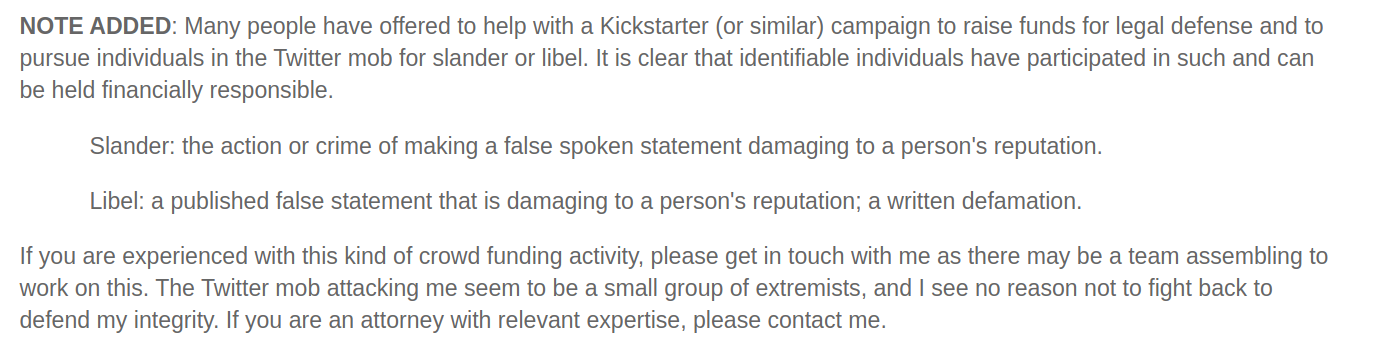
And, any claim Hsu might have had to freedom of inquiry ended the moment he threatened legal action against his critics on June 15:

NOTE ADDED: Many people have offered to help with a Kickstarter (or similar) campaign to raise funds for legal defense and to pursue individuals in the Twitter mob for slander or libel. It is clear that identifiable individuals have participated in such and can be held financially responsible. Slander: the action or crime of making a false spoken statement damaging to a person's reputation. Libel: a published false statement that is damaging to a person's reputation; a written defamation. If you are experienced with this kind of crowd funding activity, please get in touch with me as there may be a team assembling to work on this. The Twitter mob attacking me seem to be a small group of extremists, and I see no reason not to fight back to defend my integrity. If you are an attorney with relevant expertise, please contact me.

Those are the words of someone hoping to use his power to silence those who dare oppose him. And in his blog announcement when Hsu claims to stand for freedom of inquiry: those are the words of a hypocrite.

Creative Commons License
This work is licensed under a Creative Commons Attribution-NonCommercial-ShareAlike 4.0 International License.

Stephen Hsu and Ronald Unz and Holocaust Denial

 
Drawing of a human skull hooked up an electrical device. It is labeled,


Some physicists think that because they know physics, and physics is difficult, that they are qualified to work in other disciplines. Sometimes a physicist wandering from physics turns out fine, particularly if they make use of their obvious quantitative skill; I’m thinking here of David Layzer’s well-known critique of Arthur Jensen’s IQ work. Other times it is disastrous, such as William Shockley’s eugenic proposals. Yesterday evening the Graduate Employees Union (GEU) of my own university, Michigan State University, posted a long Twitter thread that shows that the  Senior Vice-President for Research and Innovation, Professor of Theoretical Physics, Stephen Hsu, here at my own university, Michigan State University is much closer to Shockley than he is to Layzer. 

I’ve written before in this space on how scientific racism gains purchase when supposedly mainstream sources publish and promote it. I find the evidence in the GEU Twitter thread to be good examples of Hsu promoting outrageous figures by appearing with them on podcasts and Youtube videos, such as that of the loathsome Stephan Molyneux.

Hsu shares a conceit all too common among physicists: that “it’s really high math ability that is useful for discovering things about the world — that is, discovering truth or reasoning rigorously.” But his behavior shows that this is manifestly untrue. All the quantitative sophistication in the world does not help in disciplines that require interpreting texts in historical contexts, understanding social nuance, or properly recounting the past for present-day audiences. Add in a heaping dose of conspiracy arguments and you can quickly end up promoting racist, especially antisemitic interpretations of history. This is what happened when Hsu interviewed his friend Ron Unz last year. The Senior Vice-President for Research and Innovation at my University heaped praise on a promoter of Holocaust denial on his podcast; clear evidence of Hsu’s complete lack of scholarly and intellectual judgement.

Continue reading

The Racist Right and “Equalitarianism”

A picture of scales perfectly balanced

Equality

Here’s a word you don’t see every day: “Equalitarianism.” What is it? According to Quillette:

According to the equalitarian model, progressives are dedicated egalitarians. They think that all individuals, all groups, all sexualities, and all sexes should be treated fairly*. They are also especially sensitive to potential threats to egalitarianism, so they adhere to the belief that all demographic groups are roughly equal on all socially valued traits, a belief we call cosmic egalitarianism. Perhaps the most common form of cosmic egalitarianism is blank slate-ism, or the belief that humans are nearly infinitely malleable, and that all important differences among them are caused by the environment, not genes. Cosmic egalitarianism serves as a protective buffer to egalitarianism because it contends two things: 1) Group disparities are caused by prejudice and discrimination (unfairness), not group differences; and 2) We absolutely should treat all groups the same because they are basically the same. Equalitarians fear that if we accept that some demographic differences are genetically caused, we might start treating groups differently from each other. For example, maybe we would encourage men to pursue STEM careers more often than women. (It is worth noting that most people who believe that there are genetically-caused demographic differences would not forward such a bad argument and are committed to treating people as individuals. However, equalitarians, as noted, are very sensitive to potential threats to egalitarianism, and they view this as a potential threat.)

Whatever you may think of this definition, you must admit that the word “equalitarianism” isn’t one you hear every day.  The Quillette article maintains that the equalitarian/progressive bias in social psychology has prevented a clear view of racial and sex differences in cognitive capacity. It is a very old and tired argument. What is noteworthy is the use of the curious term “equalitarianism” which has a sordid history that reveals the unsavory politics of Quillette when it comes to race and science.

Continue reading

Holocaust Denial and Reason Magazine: 1976

Drawing of two British colonials in wicker chairs with the label:

What I imagine the editorial room of Reason looked like way back in 1976

Although they deny it, in 1976 Reason magazine published an issue devoted to Holocaust denial.  The issue didn’t contain any claims of a worldwide Jewish conspiracy about how the Holocaust was a hoax. It was “softcore” Holocaust denial which Deborah Lipstadt defines as:

Softcore denial uses different tactics but has the same end-goal. (I use hardcore and softcore deliberately because I see denial as a form of historiographic pornography.) It does not deny the facts, but it minimizes them, arguing that Jews use the Holocaust to draw attention away from criticism of Israel. Softcore denial also makes all sorts of false comparisons to the Holocaust. In certain Eastern European countries today, those who fought the Nazis may be lauded, but if they did so with a communist resistance group they may be prosecuted. Softcore denial also includes Holocaust minimization, as when someone suggests it was not so bad. “Why are we hearing about that again?”

One of the articles in Reason was by Austin J. App, a notorious antisemite. With the notion that parody and satire can do important critical work let us imagine what the editorial meeting was like when they decided to publish a piece by Austin App. Come with me now and using the power of imagination, we will go back to 1976 and the Reason editorial board meeting….

Continue reading

The Origins of Holocaust Denial

A Map depicting Nazi concentration camps.

We are only a few weeks away from International Holocaust Remembrance Day: January 27. If you will remember, last year the Trump administration marked the day without mentioning that Jews were special victims of the Nazi regime and called the critics of of its silence asinine and and pathetic. To my knowledge, the administration has never apologized for this or amended what they said. Who knows what kind of insulting statement is in store for this year.

In anticipation of that fateful day, it might be worthwhile to explore the origins of Holocaust denial in the United States. Who was the first American to deny that the Nazis exterminated six million Jews and what was the basis for their denial?

Continue reading